iPhone Air or Galaxy S25 Edge: Which One Really Takes the Edge?
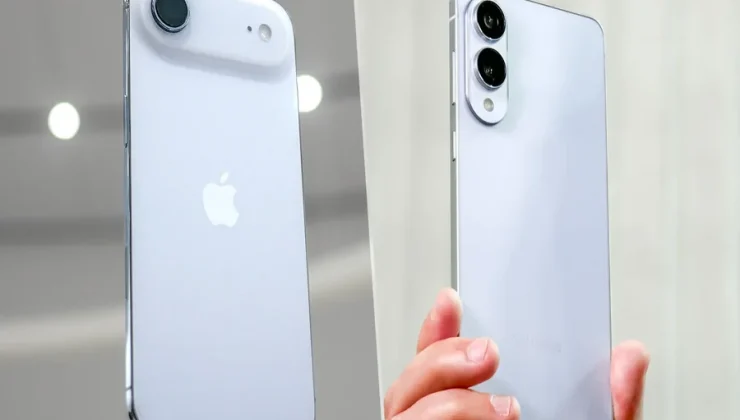
These phones were launched around the same time, are priced similarly, and have the same purpose. However, they differ in significant aspects of the phones.
Do you want to know about them? Let me share them all with you in this detailed comparison.
Samsung Galaxy S25 Edge vs. Apple iPhone Air: The Design
Well, this is the most sought-after feature of both of these phones, so let me start with that.
First things first, the thickness. iPhone Air measures at 5.6mm thick, and the Galaxy S25 Edge at 5.8mm. You really have to pixel-peep (tech slang for ‘look closely’) to see the difference between the two. They are almost identical when it comes to thickness.
Both of them are made from Titanium as well.
The major difference lies at the back of the phone: iPhone Air has a horizontal camera bar, and Galaxy S25 Edge has a vertical camera array.
Oh, and how can I forget the other major difference at the back: iPhone Air has only one camera lens at the back, and S25 Edge has a dual camera setup.
Also, even though both of these phones have an IP68 rating, Apple claims that the iPhone Air can sustain water pressure up to 6 meters of depth, while the S25 edge can only do so up to 1.5 meters.
Apart from that, more or less, both of these phones are similar in design.
Samsung Galaxy S25 Edge vs. Apple iPhone Air: The Battery and the Display
Battery is where these thin phones struggle, but Samsung’s iteration of thin is better. Let me explain.
I tested the battery life of these phones by binge-watching Game of Thrones in 4K (again). I watched Season 1, which has 10 episodes, on S25 Edge, and Season 2 (which also has 10 episodes, so it is fair) on iPhone Air. I made sure that my internet speed (Spectrum internet, in my case) was stable enough for a seamless review of battery life by reaching out to reliable and 24/7 available Spectrum customer service. The results didn’t shock me.
Samsung Galaxy S25 Edge edges out (no pun intended) Air with one hour or more of playtime. iPhone Air was dead by the end of the 9th episode, while S25 still had a 7% battery life at the end of the season.
As for the display, both of them are great because both get plenty bright outdoors, are LTPO 120Hz displays, and have thin bezels. Speaking of bezels, the S25 Edge has noticeably smaller bezels than the iPhone, and a smaller notch as well. Air’s dynamic island is big, while the S25 Edge’s small camera cutout is great for a better viewing experience.
The bottom line is that if you need a better battery and a display, go with the S25 Edge.
Samsung Galaxy S25 Edge vs. Apple iPhone Air: The Performance
I am going to give you a spoiler to save your time: iPhone Air has a better overall performance.
Last year, the iPhone 16 Plus was powered by a rather weaker chipset when compared to its Pro and Pro Max variants. But the story has changed this time around.
iPhone Air is powered by the same chipset as the Pro and Pro Max variants of the iPhone 17. However, it has one fewer core of GPU to make it more efficient. Did one less core impact the overall gaming experience?
No, it didn’t. I was able to play games smoothly via the high-speed and low-latency internet offered by Spectrum. Day-to-day tasks like checking Instagram, playing videos, and taking on calls were effortless too.
On the flip side, the Samsung Galaxy S25 Edge was fine too, but not as great as the iPhone Air. Although it has the same chipset as that of the S25 Ultra, it struggled to keep up with maximum frame rates at the highest graphics settings. Please note that it was just on the highest graphics settings. When I lowered the graphics quality, I couldn’t spot the difference in gameplay. I liked it better on the Samsung Galaxy S25 Edge because of better display and smaller notch.
However, in terms of raw power, iPhone Air was better. Anyway, if performance is your concern, get yourself an iPhone Air.
Samsung Galaxy S25 Edge vs. Apple iPhone Air: The Cameras
iPhone might be a major turn-off here because it only offers one camera at the back.
Interestingly, I was amazed to see a 200MP sensor in a phone this thin. Samsung offers two camera lenses at the back: one is the primary 200MP, and the other is an ultra-wide lens.
iPhone Air offers only one main shooter of 48MP – no ultrawide lens.
I have always liked Samsung’s cameras, so I prefer the S25 Edge over the iPhone for cameras.
Final Verdict: Which One Might Just Be the Right One for You?
Let me address the elephant in the room: if you are so much into the thin phones, I think it is better to get the Samsung Galaxy S25 Edge because iPhone Air lacks in the battery department, and doesn’t offer versatility in the cameras.